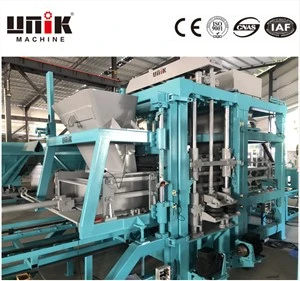
Where Does the UNIK Forming Machine Save?
In the procurement decisions of block factories, the word "save" is usually understood as a low purchase price. But over a service life of more than ten years, the stages that truly consume capital for a forming machine go far beyond the moment of purchase. The design logic of UNIK Machinery's forming machines centers on the comprehensive cost per qualified block, not the number on the quotation.
1. Servo Vibration: The Energy-Saving Logic of On-Demand Power
The UNT series forming machines from UNIK adopt a third-generation servo vibration system, with an exciting force of 50–70 kN, a vibration frequency of 3,800–4,500 r/min, a forming cycle of 15–20 seconds, and Siemens motor drive. The core advantage of the servo vibration system is not how high the peak exciting force is, but that it outputs power according to actual load demand – traditional hydraulic vibration systems operate at near-rated power in every mold cycle, while servo vibration dynamically adjusts output according to material characteristics and mold box load, reducing overall energy consumption by 20%–30% compared with traditional solutions. For a factory running two shifts per day and more than 300 days per year, the electricity cost difference corresponding to this percentage is a considerable figure over the equipment's life cycle.
2. 25 MPa Hydraulic Compaction: The Economic Value of Stable Pressure
Working in coordination with servo vibration is a 25 MPa hydraulic compaction system. Combined with high-precision proportional valves, it compacts the mix after vibration to a density of over 22 MPa, with the entire process completed within 11–14 seconds. The hydraulic system plays the role of "setting the shape" in block forming, and the repeatability of pressure output directly affects the uniformity of block height. Pressure fluctuation not only means a higher reject rate, but also means that the cement, aggregates, and energy consumed by every unqualified product all become sunk costs. UNIK's hydraulic configuration uses internationally leading brands for core components, keeping the sensitivity of proportional valves to oil contamination within design expectations and reducing hidden raw material waste caused by pressure instability.
3. Oil-Immersed Bearings and Long-Life Structure: The Cost of Downtime
The moving component on the forming machine that works under the harshest conditions is the vibrator bearing. UNIK adopts oil-immersed bearing lubrication, and the bearing's heat dissipation conditions and ability to discharge wear particles under continuous high-frequency vibration are superior to grease lubrication solutions. The main frame of the equipment uses high-strength steel, with thickened critical sections, double welding, and three-layer anti-rust treatment, with a design life of more than 12 years. The logic of this account is not "using more materials," but the number of unplanned shutdowns – an unexpected failure of a core component of the forming machine costs not only spare parts, but also the entire output of the production line during the repair period.
4. From Machine Cost to Cost Per Block
The "saving" of a forming machine should ultimately fall on the forming cost allocated to each qualified block. The electricity consumption of servo vibration, the reduction in reject rate brought by hydraulic system stability, the dilution of depreciation brought by extended structural life, and the downtime losses reduced by oil-immersed bearings – these items are dispersed throughout the equipment's entire life cycle, will not appear in the comparison column of a quotation, yet they determine the factory's actual profitability in five or ten years. Welcome to contact UNIK Machinery to obtain a full life-cycle cost evaluation of the forming machine tailored to your product plan and capacity targets.