THE SURFACE LAYER: HOW SHOULD IT BE SPREAD?
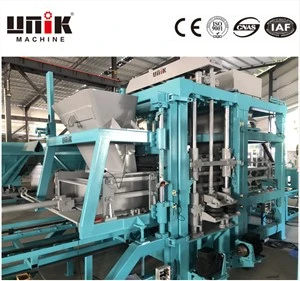
In the production of colored paving bricks, the surface layer is the most expensive and also the most "delicate" layer. UNIK Machinery's block forming machines treat double-layer spreading as a standard capability of the forming system. The surface mix and base mix are fed in separate layers and vibrated and pressed in stages. The goal is not merely "being able to produce color," but ensuring that the expensive surface layer enters every brick with controllable thickness, uniform distribution, and reliable interfacial bonding.
1. Independent Surface Layer Spreading – No "Competing for Time" with the Base Mix
UNIK's double-layer spreading process follows the sequence of "base mix first, surface mix applied afterward": the base mix is first spread into the mold cavity and pre-vibrated and pre-pressed to form a stable base layer; then the surface layer spreading device completes the surface mix placement on the already compacted base surface; finally, the entire mold is vibrated and formed as one. The surface mix does not participate in the pre-vibration stage of the base mix, avoiding downward migration of the pigment paste during base mix vibration or excessive mixing with the base mix, thereby ensuring the independence and color purity of the surface layer on the brick surface.
2. Spreading Uniformity: Using the Surface Mix "Where It Can Be Seen"
UNIK's surface layer spreading system is linked with the PLC control program. The surface mix discharge amount, spreading stroke, and scraping action are set according to the mold cavity distribution. For imitation stone textures or products requiring locally exposed aggregate, the thickness of the surface layer can be adjusted by zone according to the texture design, rather than being spread evenly across the entire brick. This "spread according to cavity" logic directly corresponds to improved surface mix utilization – the expensive layer appears only where it needs to function.
3. The Interface Between Surface and Base: Final Vibration Determines Whether It "Holds Together"
The final checkpoint for the success of double-layer spreading is the final vibration. UNIK's vibration system starts after the surface mix is spread. Vibration energy is transmitted through the mold cavity to the interface between the surface layer and the base layer, causing the cement paste in the surface mix to penetrate into the pores and rough surfaces of the base layer, forming a dual bond of mechanical interlocking and chemical adhesion. Vibration parameters – frequency, amplitude, and time – are managed by recipe according to different surface mix formulations (pigment ratio, aggregate particle size, water-cement ratio), ensuring that the surface layer and base layer of each colored paving brick become one integrated whole after demolding, rather than two layers of material stuck together.
4. The Prerequisite for One Machine, Multiple Products: Changing Molds Also Changes the Spreading Logic
UNIK's forming machine can produce colored paving bricks, imitation stone PC bricks, curbstones, and other products by changing molds. When switching from ordinary paving bricks to imitation stone texture bricks or dual-color bricks, the corresponding surface spreading program and vibration parameter recipe in the PLC are called up simultaneously, so operators do not need to figure out anew "how much surface mix to spread and how long to vibrate for this brick." This design of binding molds with process recipes keeps surface mix loss and first-mold reject rates within controllable limits during multi-variety production.
Welcome to contact UNIK Machinery to obtain an evaluation of double-layer spreading and forming configuration tailored to your colored paving brick or imitation stone product plan.