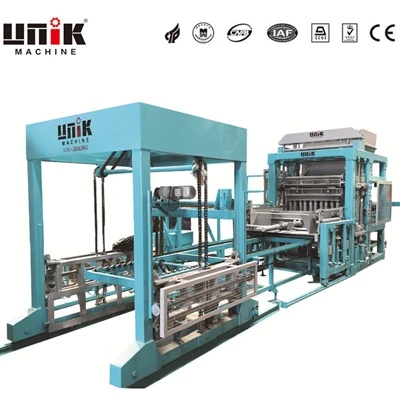
Why Do the Vibration Frequency and Amplitude of a Block Forming Machine Determine the Final Strength of the Blocks?
In a concrete block production line, the forming machine is the heart of the entire line, and the vibration system is the "pacemaker" of that heart. Many factories focus on the forming cycle and production capacity of the forming machine when selecting equipment, but often overlook the vibration parameters – vibration frequency, amplitude, and vibration acceleration – which have a decisive impact on block density and final strength. In fact, block forming machines rely on vibration and pressure to shape and compact the concrete mix in the mold box, and the selection of vibration parameters is crucial to block performance.
1. Vibration Acceleration: The Key Indicator Determining Compaction Effectiveness
In the vibration forming process, what truly determines the compaction effect is not the "form" of vibration, but the magnitude of vibration acceleration. The vibration acceleration of mold vibration forming machines is approximately 10‑19 g, with a vibration forming time of about 1‑3 seconds; the vibration acceleration of table vibration forming machines is approximately 5‑8 g, with a vibration forming time of about 3‑5 seconds. For mold vibration forming machines with a vibration forming time of only 1‑2 seconds, further increasing vibration acceleration is of little significance – because another key parameter affecting concrete vibration compaction is the vibration duration. If the vibration time is too short, the mix cannot be fully blended; if the vibration time is too long, the concrete density will not increase significantly, and sometimes segregation and layering may occur, reducing block quality.
2. Vibration Intensity: A Comprehensive Parameter for Evaluating Vibration Effectiveness
Vibration intensity (L) is a comprehensive parameter for evaluating compaction effectiveness, proportional to the square of the amplitude (B) and the cube of the frequency (n), i.e., L = B²n³. For concrete of different stiffness levels, the required vibration intensity differs: dry‑hard concrete requires a vibration intensity of approximately 200‑600 cm²/s³, while extra‑hard concrete requires as much as 600‑800 cm²/s³. This means that to increase vibration intensity, it is preferable to increase frequency rather than amplitude – because L is proportional to the cube of n, so the effect of increasing frequency on intensity is faster.
3. Vibration Parameter Range of Mainstream Domestic Forming Machines
From the practical application of domestic block forming machines, the generally adopted vibration parameter range is: vibration frequency 45‑55 Hz, amplitude 1‑2.2 mm, and vibration acceleration 10‑18 g. This parameter range is the result of equipment manufacturers striking a balance between vibration effectiveness and the service life of the vibration system (especially the bearings).
4. Pressing Force Value: Synergistic Action with Vibration
During forming, while the vibration table vibrates, the press head simultaneously descends, applying a certain pressure to the upper part of the block. The purpose of pressing is, first, to accelerate the settling of the mix in the mold box and shorten the vibration time; second, to increase concrete density, achieve the required block height, and make the top surface of the block level. Forming machines with larger amplitudes typically have correspondingly larger pressing force values to match the stronger vibration energy output.
For block plants, understanding the internal logic of vibration parameters not only helps in making more scientific judgments during equipment selection, but also enables continuous improvement of product strength consistency and stability through parameter optimization in actual production.