Once the Equipment Is Sold, Does Service Just Begin?
In the traditional equipment procurement logic, once the contract is signed, the equipment shipped, and installation and commissioning completed, a transaction is "finished." But for a block production line running in Africa, Southeast Asia, or the Middle East, the real test begins exactly after the equipment goes into production.
A 2026 industry report points to a clear trend: the concrete block equipment market is shifting from "selling equipment" to "selling services," and predictive maintenance and remote O&M will become standard capability configurations for equipment manufacturers between 2026 and 2030. Behind this shift is customers' need for certainty that "the equipment is actually running when it should be running," which is surpassing comparison of initial purchase prices.
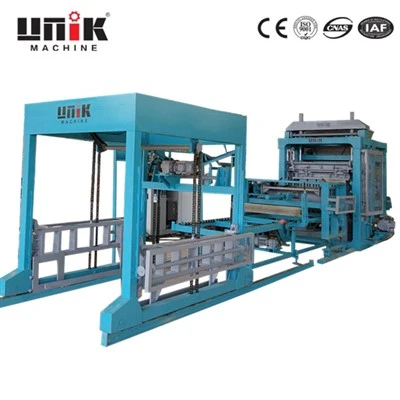
In its complete-line deliveries, UNIK Machinery treats service capability as a deliverable equally important as equipment performance. The response time of its remote support network has been shortened from 24 hours in the early days to within 6 hours, covering all time zones. For customers in Sri Lanka, Ghana, Indonesia, and other locations, this means that when abnormalities occur on the production line, the technical team can intervene within hours, rather than waiting days for international travel. In key markets such as Indonesia, the deployment of localized service personnel further shortens the on-site response cycle for complex problems.
The value of this service model lies not in "fast after-sales response" itself, but in the fact that it changes the cost structure of equipment failures. TCO analysis shows that the initial purchase price of a block machine accounts for only 15%–25% of its total lifecycle cost, while operation, maintenance, and hidden downtime losses account for the vast majority. The approximately 40% higher annual failure rate of low-priced equipment, and the downtime losses accumulated over several years of operation, are enough to offset all the price difference saved at the time of purchase. UNIK incorporates real-time monitoring of energy consumption and equipment health via the 5G-IoT platform into its complete-line deliveries. The purpose is not to add an "intelligent" label, but to make equipment degradation visible before it evolves into downtime, and to turn maintenance from "fix it after it breaks" into "maintain it when maintenance is due."
The 2026 industry report also points out that Southeast Asia and South Asia are becoming the fastest-growing regions for block equipment demand, and a common feature of these markets is that local technical maintenance resources are relatively weak, with a higher dependence on remote support and low-threshold O&M. UNIK's complete-line delivery logic is precisely to incorporate "what happens after the equipment arrives at the customer's factory" into the design scope – from the technical requirements for the installation foundation, to operation and maintenance training, and further to remote diagnostics and regional service coverage. The value of equipment is ultimately reflected in the qualified blocks it continuously produces throughout its entire lifecycle, not in the parameter sheet at the moment it leaves the factory.
Welcome to contact UNIK Machinery to learn about the service configuration and remote O&M solutions in complete-line deliveries.