

From 'Experience‑Based Batching' to' Precision Smart Batching': Key Technologies in Automatic Batching and Mixing Systems for Concrete Block Production
In concrete block production, the batching and mixing stages are the core of product quality and production cost. However, many small‑to‑medium‑sized block plants still rely on manual or semi‑automatic methods for aggregate weighing and mixing – not only inefficient, but also leading to product strength fluctuations and significant cement waste due to weighing errors. With the industry's growing demands for product consistency, energy efficiency, and environmental compliance, the coordinated operation of automatic batching stations and forced mixers has become a key breakthrough for block plants to reduce costs and increase efficiency.
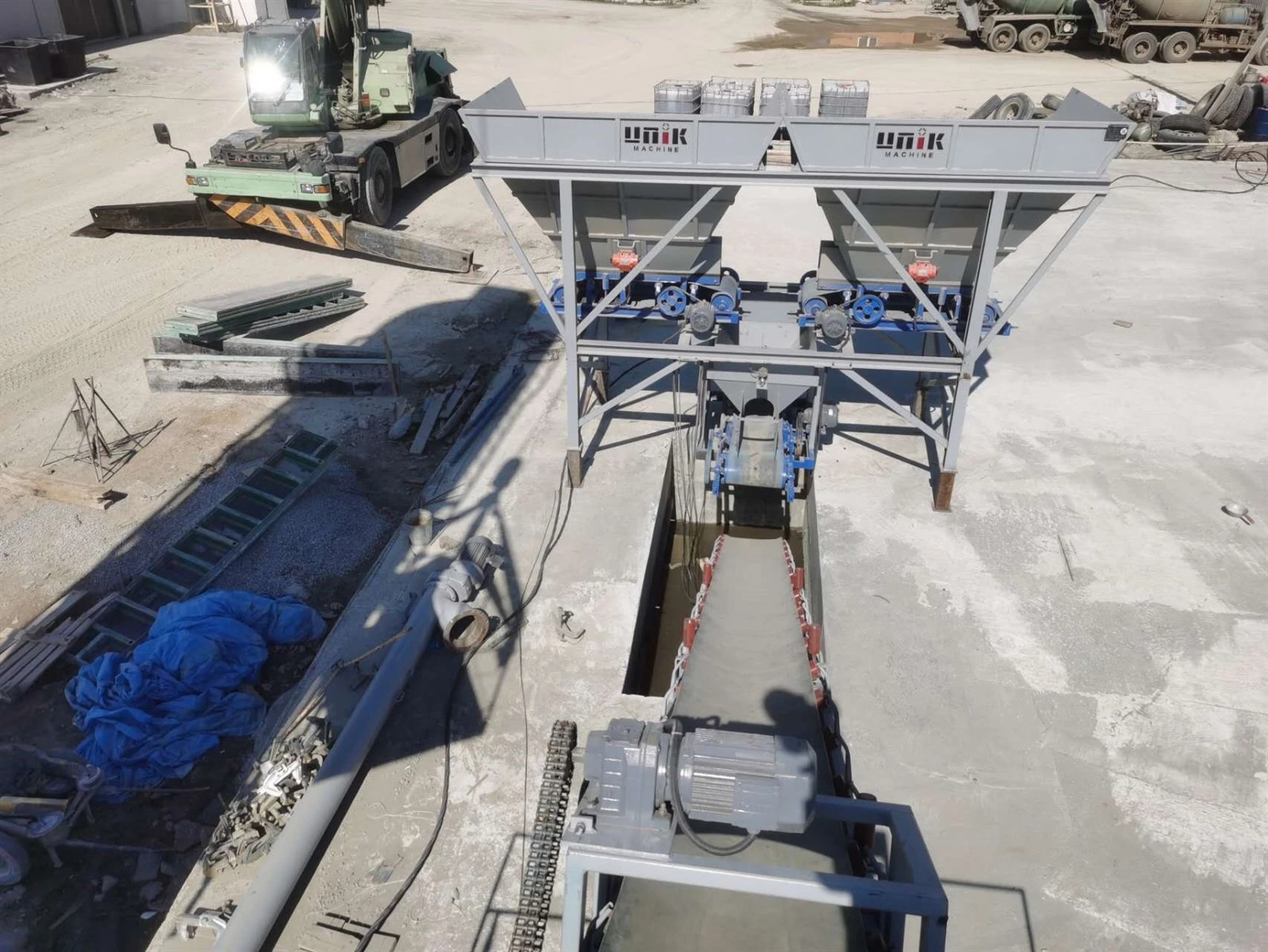
1. Electronic Weighing Sensors: A Precision Leap from ±5% to ±2%
Traditional manual batching typically has an error margin of over ±5%. In contrast, modern automatic batching stations use electronic load cells for weighing. Taking UNIK Machinery's PL series batching stations as an example, the PL800, PL1200, and PL1600 models offer weighing capacities of 0.8 m³, 1.2 m³, and 1.6 m³ respectively, all achieving a batching accuracy of ±2%. This improvement in precision means that the cement content per cubic meter of concrete can be precisely controlled – avoiding both the quality risk of insufficient strength and the cost waste of excess cement.
2. Forced Mixing: Process Assurance for High‑Uniformity Concrete
The mixing stage, which follows batching, directly determines the uniformity of the concrete. Unlike traditional gravity mixers, the JS series twin‑shaft forced mixers use mixing arms to create forced shearing and convective movement, thoroughly mixing cement, aggregates, water, and admixtures in a short time. From the JS500 to the JS2000, the discharge capacity covers 500L to 2000L, with unit productivity ranging from 25 m³/h to 120 m³/h. For large block plants with an annual output exceeding 100,000 m³, high‑capacity mixers can significantly shorten batch intervals and increase overall line capacity.
3. System Coordination: Seamless Integration of Batching – Mixing – Conveying
The value of a fully automatic production line lies not only in the performance of individual machines, but also in system coordination. After the batching station completes weighing, aggregates and cement are conveyed via belt conveyor to the mixer. After mixing, the concrete is conveyed through the same system to the hopper of the block forming machine. The entire process is centrally controlled by a computer, reducing manual intervention and material loss during transfer. This integrated "batching–mixing–conveying" design forms the technical foundation for achieving continuous, standardized production in modern fully automatic concrete block production lines.
4. Selection Recommendations: Smart Decisions Based on Capacity and Product Mix
For investors planning to build or upgrade a block plant, the selection of batching stations and mixers should be based on target production capacity and product type. When producing high‑precision paving bricks or decorative blocks, which demand higher batching accuracy and mixing uniformity, it is recommended to choose at least a PL1200 batching station paired with a JS1000 or larger forced mixer. For producing ordinary infill blocks, a lower specification can be selected to control initial investment.