On the Conveying Line, Where Does the Money Leak?
In the cost accounting of block factories, cement, aggregates, labor, and energy consumption are usually the focus. But what truly keeps eroding profits is often the conveying links connecting each process – material spillage on belts, blockages in screw conveyors, and pallet jams during pallet return. These "minor faults" may cause limited losses individually, but accumulated, they directly drag down the effective output of the entire line.
1. The Belt's "Spillage Account": Misalignment Is Not a Posture Problem, but a Cost Problem
Belt conveyors handle the transfer of aggregates and mixes in block production lines, and material spillage is one of the most frequent faults. The causes of spillage are not singular: when the belt misaligns, the two sides are at different heights and material slides off the lower side; when the rubber skirt of the guide chute wears out or the gap is too large, material overflows through the gap; when the discharge point is not centered, material becomes offset-loaded and concentrates on one side of the belt over time. Every kilogram of spilled aggregate is a cost that has already been paid for procurement, transportation, and batching, yet it never enters the mixer. A more hidden cost is that spilled material requires manual cleanup; if not cleaned up in time, it accelerates wear on the idler rollers and the belt, forming a vicious cycle of "spillage – wear – worsening misalignment – more spillage." The root cause of misalignment often lies not in the belt itself, but in the installation accuracy of the idler roller groups, the parallelism of the pulleys, or the condition of the tensioning device – these "minor installation deviations" are amplified over day-after-day operation into continuous cost leakage.
2. The Screw Conveyor's "Blockage Account": One Shutdown Is Not Just a Few Tons of Cement Less
The cement screw conveyor connects the silo and the batching scale and is the throat through which powder enters the production process. Once blockage occurs, emergency handling requires shutdown and power cut, opening the inspection port for manual clearing, and forced startup is strictly prohibited to avoid burning out the motor. Downtime ranges from tens of minutes to several hours, during which the forming machine has no material available and the entire line's output drops to zero. Among the causes of blockage, uneven feeding and high material moisture content are two high-frequency factors: instantaneous overfeeding exceeds the conveying load, and powder accumulates inside the machine; moisture causes cement to harden in the trough and gradually block the passage. A "minor noise" easily overlooked in daily maintenance – the squeaking of the hanger bearings – is often a precursor to screw shaft sagging; if not addressed in time, it eventually develops into catastrophic damage to the screw flights and the trough.
3. The Pallet Return's "Jam Account": One Warped Pallet Jams the Entire Line
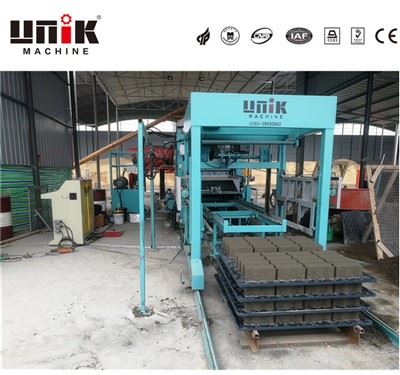
The pallet return system appears to simply "send empty pallets back to the forming machine," but its reliability directly determines whether the forming machine can run continuously. Uneven pallet thickness or warped corners and edges are the primary causes of pallet jams; pallets that are too thin may also cause two pallets to be mistakenly fed at once, disrupting the forming rhythm. More critically, if the connection design between pallet return and the palletizing stage is unreasonable, once the palletizing system fails, pallets cannot return to the forming machine, and the entire production line is forced to stop – the independence of the pallet return system is essentially buying "redundancy insurance" for the entire line.
The cost of the conveying stage is never listed as a separate item on the procurement list. It is dispersed in every cleanup of spillage, every shutdown due to blockage, and every handling of a pallet jam. Only by gathering these "dispersed leakages" together can we see the truly controllable profit space of a block factory.