



interlocking block making machine in india
Products Description

Technical specification:
| Dimension | 5000×2450 ×2930mm |
| Weight | 6T |
| Pallet size | 880 ×680mm |
| Power | 42.15 kW |
| Vibration method | Siemens motors |
| Vibration Frequency | 3800-4500 r/min |
| Cycle time | 15-20s |
| Vibration Force | 50-70KN |
Main features
From "Laying Walls" to "Assembling Walls": A Technology That Is Changing the Way India Builds
In India, the way walls are built is undergoing a fundamental change.
Traditional brick walls require one brick, one layer of mortar at a time – waiting for the mortar to dry before continuing. This process is not only time‑consuming but also heavily dependent on skilled labor. Against the backdrop of rising labor costs and a shortage of skilled workers in India's construction market, the limitations of traditional wall‑building methods are becoming increasingly evident.
Interlocking blocks are changing all of this.
These concrete blocks, with their tongue‑and‑groove design, require no mortar during construction – they interlock like puzzle pieces to form stable wall structures. In the vertical direction, mortar usage can be reduced by up to 80%. Construction speed is several times faster than traditional methods, with no need to wait for mortar to cure – project timelines are significantly shortened. In India's earthquake‑prone regions, the tongue‑and‑groove structure of interlocking blocks provides better load distribution and seismic performance. At the same time, interlocking blocks can be produced using industrial waste such as fly ash and quarry stone dust, meeting the Indian government's requirements for green building and sustainable development.
An interlocking block making machine is the key equipment that transforms this technology from concept into large‑scale production.

I. Interlocking Precision Determines Wall Stability
The key to interlocking blocks lies in the fit precision between the tenons and grooves.
UNIK molds are made of Cr12MoV and 9CrSi alloy tool steels.
Processed through carburizing heat treatment.
Surface hardness: HRC 59‑62.
Critical dimensional tolerances are controlled within ±0.3 mm.
Ensuring that each block precisely interlocks with adjacent blocks.
The cavity surface finish is Ra 1.6 or higher.
All internal corners are machined with 3‑5 mm radii.
To eliminate stress concentration points and prevent fatigue cracks.
II. ±20% Wide Voltage Design – Responding to Grid Fluctuations in India
The Indian industrial standard voltage is 415V/50Hz.
But voltage fluctuations are common in actual operation.
UNIK equipment can withstand fluctuations of ±20%.
Comes standard with undervoltage protection and automatic restart functions.
In areas with unstable power supply, this means less downtime.
| Products | Pic | Size | Capacity | Cycle time | Daily capacity |
| Hollow block |  |
390 ×190 ×190mm | 5pcs/pallet | 15-20s | 7200pcs |
| Hollow brick |  |
240 ×115 ×90mm | 16pcs/pallet | 15-20s | 23040pcs |
| Brick |  |
240 ×115 ×53mm | 34pcs/pallet | 15-20s | 48960pcs |
| Paver |  |
200 ×100 ×60mm | 20pcs/pallet | 15-20s | 28800 pcs |
Our factory.
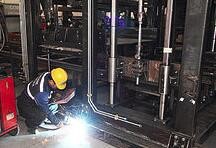
Manufacturing

Delivery

workshop

Process
Hot Tags: interlocking block making machine in india, China, manufacturers, suppliers, factory, wholesale, customized, buy, price, quotation, price list, for sale, made in China


